What Is Steamy Co-Author? A 3-File AI System for Dark Romance
Disclosure: this article contains an affiliate link. If you buy through it, we may earn a commission.
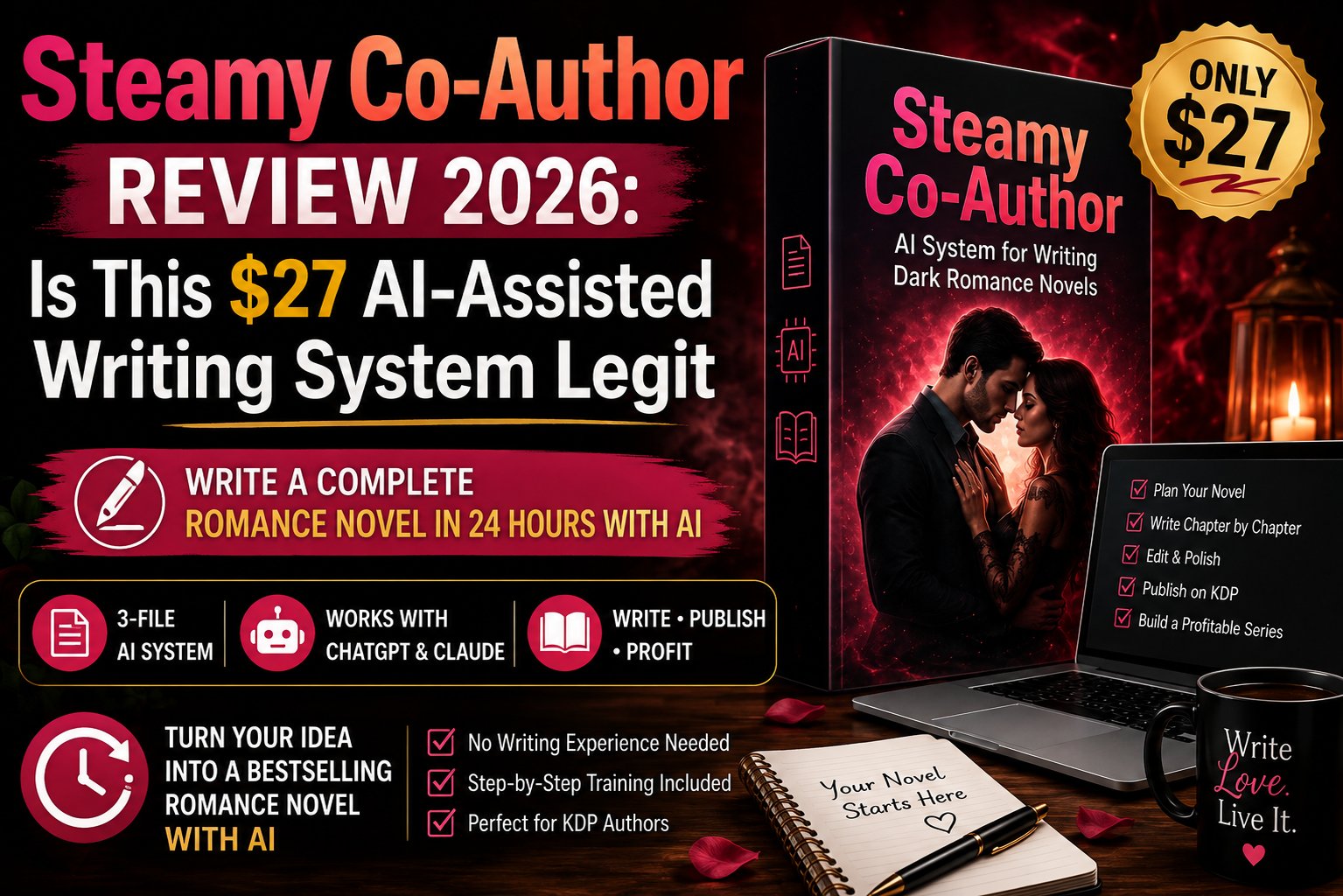
Steamy Co-Author is a three-file AI writing system for publishing dark romance novels on Kindle. It works with Claude and ChatGPT, uses fifteen guided questions across three documents, and builds books chapter by chapter. One user reports publishing a bestselling trilogy in 13 days using it.
What Steamy Co-Author actually is
Steamy Co-Author isn’t software, an app, or a subscription service. It’s a structured workflow — delivered as three editable files — that guides users through novel creation using large language models they already have access to (Claude and ChatGPT). Each file corresponds to a phase: idea expansion, chapter scaffolding, and continuity control.
The system doesn’t generate text on its own. Instead, it gives precise prompts and constraints so the AI writes with the user, not for them. The user stays in charge of pacing, tone, and character decisions; the AI handles sentence-level drafting under tight direction.
The “three-file” structure replaces open-ended prompting. Instead of vague requests, users answer fifteen specific questions — e.g., “What is the heroine’s secret fear?” — then paste answers into the files. Those inputs become the foundation for AI-generated chapters.
How it works in real use — feature by feature
Each of the three files serves a concrete purpose. None require coding, installation, or technical setup. All are plain-text or Word-compatible documents — editable in any free word processor.
File 1: The Idea Engine
This file turns a single concept — like “a forbidden affair between a vampire barista and a werewolf health inspector” — into a viable story framework. It asks fifteen questions, grouped into three categories: characters (motivations, secrets, contradictions), world rules (how magic works, social stakes, consequences), and core conflict (what stops them from being together, and what forces them closer).
Answers here feed directly into Files 2 and 3. In practice, this means users spend 20–45 minutes clarifying their vision before any chapter drafting begins — cutting down on mid-draft rewrites.
File 2: The Chapter Builder
This file converts File 1’s answers into chapter-by-chapter prompts. Each chapter section includes: – A fixed “beat list” (e.g., “introduce tension in first 100 words”, “reveal one hidden trait before the midpoint”) – A “tone guardrail” (e.g., “no internal monologue from the hero until Chapter 4”, “all dialogue must contain at least one subtextual layer”) – A “heat-level dial” (low/medium/high — adjustable per chapter)
Users copy-paste File 1 answers into labeled fields, then run the prompt in ChatGPT or Claude. The AI outputs a full chapter draft that follows those constraints.
File 3: The Continuity Keeper
This file acts as a live reference hub. It contains three tables: – Character Tracker: Name, age, key physical detail, secret, and one unbreakable rule (e.g., “never lies to family”, “always carries a lockpick”) – World Rule Log: Each magic/sci-fi/fantasy element with its cost, limit, and one observed consequence – Plot Thread Map: Every subplot (romance, mystery, revenge) with its current status (“active”, “dormant”, “resolved”), last appearance chapter, and next required beat
Before each new chapter, users update these tables with new details.
Tip: Start with File 1 alone. Complete just the first five questions — character motivations and secrets — then try one chapter in File 2. If the AI output feels off-brand or inconsistent, go back and tighten those five answers before adding more. Less input, better control.
Who it’s for — and who should pause before buying
Steamy Co-Author suits people who want to publish Kindle novels but don’t identify as writers — especially fans of dark romance, romantic suspense, or paranormal romance. It helps most when the user has clear taste preferences (e.g., “I love enemies-to-lovers with slow-burn tension”) but lacks confidence in structure, pacing, or consistency. The system rewards specificity: the more precise the File 1 answers, the tighter the AI output.
It isn’t for people who want fully automated writing. There’s no “generate full book” button. Users must read, edit, and approve every chapter. They must also make judgment calls — for example, deciding whether a scene’s tension level matches their intent, or whether a character’s reaction feels authentic. The files guide; they don’t replace taste.
It’s also not for people who expect plug-and-play compatibility with every AI tool. The facts state it works with Claude and ChatGPT — not Gemini, Copilot, or open-source models. If a user only has access to a different model, they’d need to adapt the prompts manually (no guidance for that’s provided).
Before buying, confirm two things: – You have active access to either Claude (via claude.ai) or ChatGPT (via chat.openai.com), including the version capable of following multi-step instructions (GPT-4 or Claude 3 Opus recommended, though not required) – You’re comfortable working in plain documents — copying text between files and AI windows, updating tables, and reviewing drafts line by line
No technical skill beyond basic copy-paste is needed. But willingness to engage actively — not just run prompts and accept output — is essential.
Key limitations and realistic expectations
Steamy Co-Author doesn’t guarantee bestseller status, Amazon ranking, or royalties. Kindle success depends on many factors outside the system: cover design, blurb quality, pricing, category selection, and marketing. The system builds the book; it doesn’t launch it.
Finally, it doesn’t handle formatting for KDP. Exporting a manuscript to Kindle Direct Publishing requires separate steps: converting to .docx or .epub, applying proper heading styles, inserting page breaks, and checking image resolution. Steamy Co-Author delivers content — not production-ready files.
Comparison: Steamy Co-Author vs. other AI writing tools
| Feature | Steamy Co-Author | Generic AI Writing Tools (e.g., Sudowrite, Jasper) | Basic ChatGPT Prompting |
|---|---|---|---|
| Structure | Fixed three-file workflow with built-in checks | Flexible templates, but no enforced continuity system | No structure — user creates prompts from scratch |
| Genre Focus | Built for dark romance tropes and pacing | Broad genre support, but no deep trope logic built in | Zero genre awareness unless user specifies |
| Consistency Aid | File 3 tracks characters, world rules, and plot threads in real time | Some offer “memory” features, but no visual thread mapping | None — user must remember or re-prompt manually |
| User Skill Required | Clear answers to 15 questions; no writing theory needed | Familiarity with genre terms and editing judgment | High — user must diagnose and fix every inconsistency |
| Output Control | Beat lists and tone guardrails constrain AI behavior per chapter | Style presets exist, but less granular per-scene control | Full control — and full responsibility — over every prompt |
This comparison shows Steamy Co-Author occupies a narrow but distinct space: it trades flexibility for reliability in a specific use case.
Common buyer doubts — answered plainly

People considering Steamy Co-Author often ask the same practical questions — not about hype, but about fit.
Is Steamy Co-Author safe to use with my existing AI accounts?
Yes. It uses only standard web interfaces for Claude and ChatGPT — no logins, no API keys, no software installation. You paste prompts manually, just as you would for any other task. There’s no risk to your accounts, data, or subscriptions. Neither Claude nor ChatGPT restricts this type of prompt usage.
Can I use it for genres other than dark romance?
The facts describe it as built for dark romance, and its prompt structures reflect that genre’s conventions (tension pacing, power dynamics, heat-level calibration). While nothing technically prevents using it for romantic suspense or paranormal romance, the beat lists and tone guardrails may not align with, say, cozy mystery or epic fantasy pacing. Adapting it requires rewriting those elements — which the facts don’t address.
Does it include publishing guidance or Amazon optimization?
No. The facts mention KDP royalties and ranking, but Steamy Co-Author itself delivers only the three files and instructions for using them with AI. It doesn’t include advice on keywords, categories, pricing, or cover design — all critical for Kindle success.
What if I get stuck on the fifteen questions?
The facts don’t include tutorials, video walkthroughs, or support forums. There’s no stated refund policy or customer support channel in the facts provided.
Is it compatible with mobile devices?
The facts don’t specify device compatibility. Since it relies on copying text between web-based AI tools and editable documents, mobile use is possible but likely cumbersome — small screens make multi-window work difficult, and mobile keyboards slow down text entry.
Frequently Asked Questions
Does Steamy Co-Author require coding or technical setup?
No. It requires only a web browser, access to Claude or ChatGPT, and a word processor that opens .txt or .docx files. No installation, no accounts to create, no APIs to configure. Everything runs in your browser window.
Can I use Steamy Co-Author if I’ve never written anything before?
Yes — that’s its core audience. The facts state “You Do Not Need To Be A Writer” and “Even if you have never written a page in your life.” The system replaces narrative intuition with structured inputs, making it accessible to absolute beginners.
Does it work with free versions of ChatGPT or Claude?
Yes, according to the facts — it works with both tools, and neither specifies a paid tier. However, free tiers may limit context length or output quality. For best results, users should verify their plan allows long, detailed prompts and retains memory across sessions.
Is Steamy Co-Author updated regularly with new features?
The facts don’t mention updates, version numbers, or a roadmap. It’s presented as a static system — three files and fifteen questions — with no indication of ongoing development or user feedback loops.
Can I sell books I write with Steamy Co-Author commercially?
Yes. The facts describe publishing “a bestselling dark romance series” and earning “KDP royalties.” Nothing restricts commercial use. However, users remain responsible for copyright compliance — for example, ensuring AI-generated content meets Amazon’s content policies.
Does Steamy Co-Author store or collect my data?
The facts don’t state that it collects, stores, or transmits any user data. Since it consists only of downloadable files and uses external AI tools, no data passes through a Steamy Co-Author server. All input and output stay on the user’s device or within their chosen AI platform.
Who should try Steamy Co-Author — and what to do next
Steamy Co-Author is for readers who devour dark romance and wonder, “Could I build something like this?” — not for aspiring literary novelists or technical writers.
Before buying, confirm you have reliable access to Claude or ChatGPT — and that you’re prepared to treat the three files as active tools, not passive templates. Open File 1 now and answer just the first question: “What makes this couple impossible to be together?” Write one sentence. If that sparks excitement, Steamy Co-Author gives you the scaffolding to build ten chapters around it — step by step, file by file.